
Module of group triggers
Triggers are special keywords. If the bot see this keyword in the group, he can react on this by sending the predefined message to the group.
To configure Triggers, go to the group editing menu:🔐Admin | 🧫Channels and Groups
● Select a Group (Trigger are configured for each group separately)
● Go to the «Triggers» section
❖ Trigger settings
Trigger settings can be Global and Individual.
IMPORTANT: How Global and Individual Trigger Settings work.
Global Settings are set for the entire Group and are the "single source of truth" for all Triggers. By changing one Global Setting, you automatically update its value for all Triggers that use the Global value, since they (without their own value) directly access this (global) source each time they triggered.
Individual Parameters for each Trigger can take values from the Global Settings (if applicable), and also have Individual values. In the Individual Trigger Settings, any Global value can be reassigned, making it Individual. If you have assigned a Individual value to a Trigger that is similar to the Global Setting, it will NOT change when the Global Setting is changed, since it is already locked as Individual.
When creating a new Trigger, its Individual Parameters will contain values from the Global Settings (where applicable) and Individual Default Values - for those parameters that cannot have a Global Value.
Global Trigger Settings
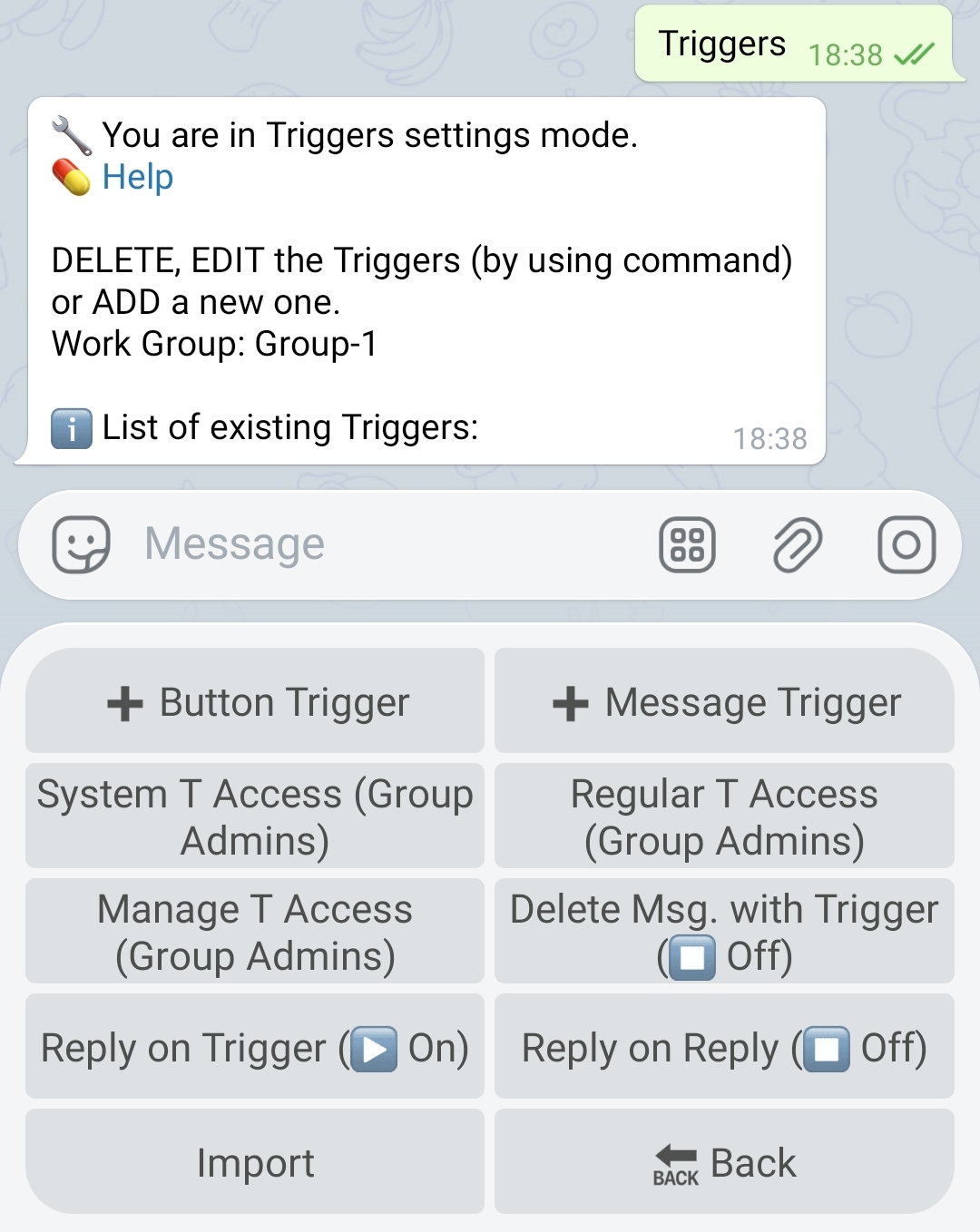
System Triggers Access
Determines who has access to use System Triggers sent to the group.
Modes: Group Admins - Group Admins only. Bot Admins - Bot Admins only. All Admins - both - Group Admins and Bot Admins. SYSTEM TRIGGERS are all triggers listed in this section, as well as all triggers from the «Module of Moderation» section.
Manage Trigger Access
Determines who has permission to add and remove Regular Triggers (those ones you adding yourself).
Modes:Group Admins - Group Admins only.Bot Admins - Bot Admins only.All Admins - both - Group Admins and Bot Admins.
Regular Triggers Access
Determines who has access to Regular Triggers (those ones you added yourself) sent to the group.
Modes:Group Admins - Group Admins only.Bot Admins - Bot Admins only.All Admins - both - Group Admins and Bot Admins.All - Everyone has access, including regular users.
Delete Message with Trigger
Determines whether messages with Triggers are deleted after the bot responds to them (this includes both - Triggers sent to the group and those used in messages (on-entry, by occurrence)).
Modes:Off ⏹️ - disabled (the message with the Trigger will remain in the chat).On ▶️ - enabled (the message with the Trigger will be deleted).
Reply to Trigger
Determines whether the response to the trigger will be sent as a "Reply".
Modes:Off ⏹️ - disabled (sent as a regular message).On ▶️ - enabled (sent as a "Reply").
This setting will be ignored if the «Delete Message with Trigger» mode is enabled, as this means deleting the message with Trigger it self.
Reply on Reply
If the trigger was sent as a reply to a chat message, the bot will also send a reply to that message as a "Reply".
Modes:Off ⏹️ - disabled (send as a regular message).On ▶️ - enabled (send as a Reply).
Individual Trigger Settings
Setting up of Individual Trigger's Parameters is available in the Trigger Editing Wizard (see below) - when adding a new Trigger or editing an existing one.
Access to this Trigger
Determines who can use the Trigger (this setting overrides the Global setting).
Modes:As Global - default - the state is taken from the Global Trigger Settings.All - everyone has access, including regular users.Group Admins - Group Admins only.Bot Admins - Bot Admins only.All Admins - both - Group Admins and Bot Admins.
Trigger By Occurrence
The trigger will be recognized within a sentence. "By occurrence" triggers, such as "bonus," will be searched for within the message text and triggered by phrases like "how to get a bonus".
Modes:Off ⏹️ - default - this is a standard Trigger and will be ignored if there is no exact match.On ▶️ - the Trigger will be recognized even within the sentence text.
Whose Data (in the Message)
This setting determines whose data is included in the Macros of Trigger's message.
Modes:Default - Defined by Context - will work as it currently does - the Response Author's data will be included everywhere, and the User's data will be included in Forms.Of Source Author - the Macros of Trigger's message will forcibly include the data of original message author (the one being replied to).Of Reply Author - the Macros of Trigger's message will forcibly include the data of response Author (the one who sent the Trigger, usually the Admin).
Delete Trigger Name
Determines whether messages containing the Trigger Name in chat should be automatically deleted (this setting overrides the Global setting).
Modes:As Global - default - the state is taken from the Global Trigger Settings.Off ⏹️ - will not be deleted.On ▶️ - will be deleted.
Delete Source Message
Allows you to delete the original message (the one to which a reply was sent with the Trigger).
Modes:As Global - default - the state is taken from the Global Trigger Settings.Off ⏹️ - will not be deleted.On ▶️ - will be deleted.
Do Not Send Answer
The Trigger will not send its Associated Message (it will only perform ALL other actions, if any).
Modes:Off ⏹️ - default - will send (normal behavior).On ▶️ - will not send.
Used in combination with other settings, such as «Delete Source Message».
Restrict User
This setting allows you to impose restrictions on the user of the original message.
Modes:Off ⏹️ - default - no restrictions.⛔️ Ban - prevent the user from posting to the group (mute).📛 Kick - remove the user from the group.
This is an old, original terminology from the Telegram documentation - we'll fix it someday. 😁
❖ How to add Triggers
At the moment, the bot has 2 types of triggers.
Button Trigger - associates with bot buttons. To set a trigger, you must create a button, add a message to it (or select an existing button with an existing message), and associate the desired Trigger Name with it.
Message Trigger - this Trigger can be assigned directly by adding a message to the bot in the Trigger's Settings, or in the group (where the bot is running) by using commands in response to any message.
For a Button Trigger, it doesn't matter whether the button is accessible from the menu, closed by a Condition, or hidden: the trigger will always work for it.
In Trigger messages in groups, Inline buttons with Commands do not work and are not displayed.
All triggers are case-insensitive: they are always stored in lowercase letters and will work no matter what case they are entered in, for example "Test trigger" or "TeSt TrIgGer".
Messages displayed in a group using Triggers can contain their own inline buttons. Of all the inline buttons in this message, inline buttons containing Commands will not be displayed in the group. However, if the same message is displayed in the bot itself - for example, if the Trigger is used in response to a user's message from a QnA chat Form (and the triggered message is sent to the user in the bot) - all buttons will be fully displayed, and the user can use the button with a Command, just like a regular inline button in the bot. This can be used to create interesting mechanics.
For buttons specifically designed for triggers, a good practice is to create a dedicated sub-menu (or several sub-menus), hide its entry using the «Admin Only» button mode, and then create buttons and messages for the triggers within it. Well, at least that's what we do. :)
New «Button Trigger»
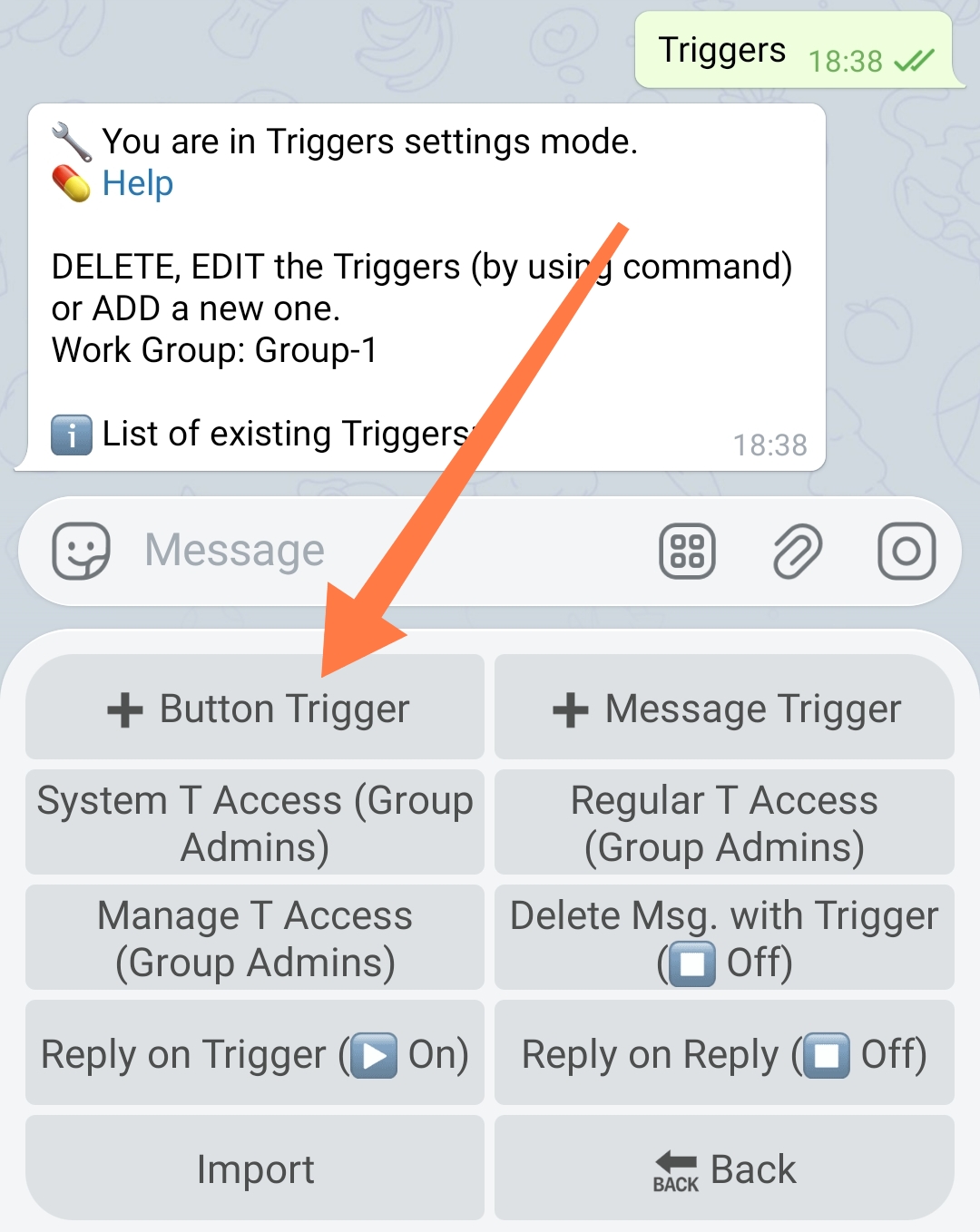
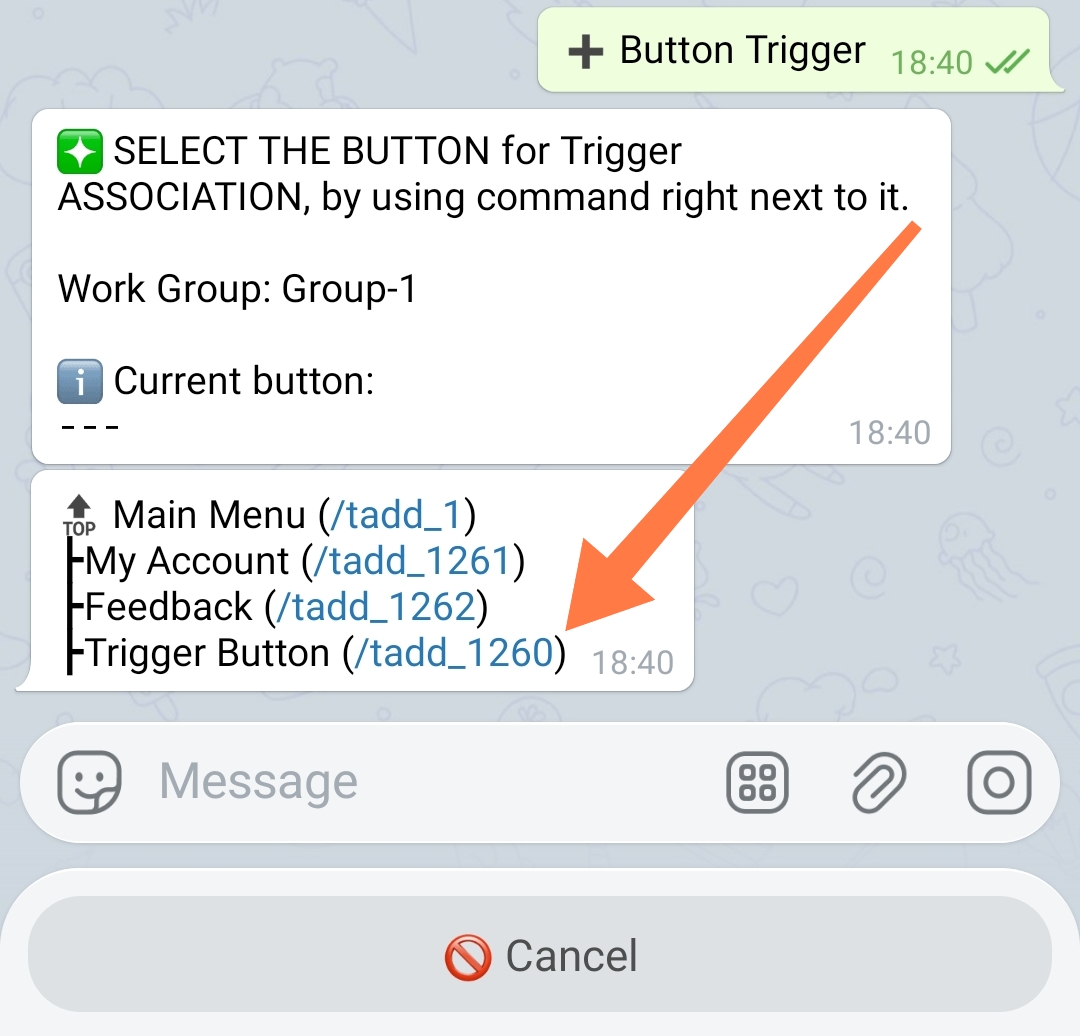
1. Select «➕ Button Trigger»
You will see all the buttons of your menu in a tree view.
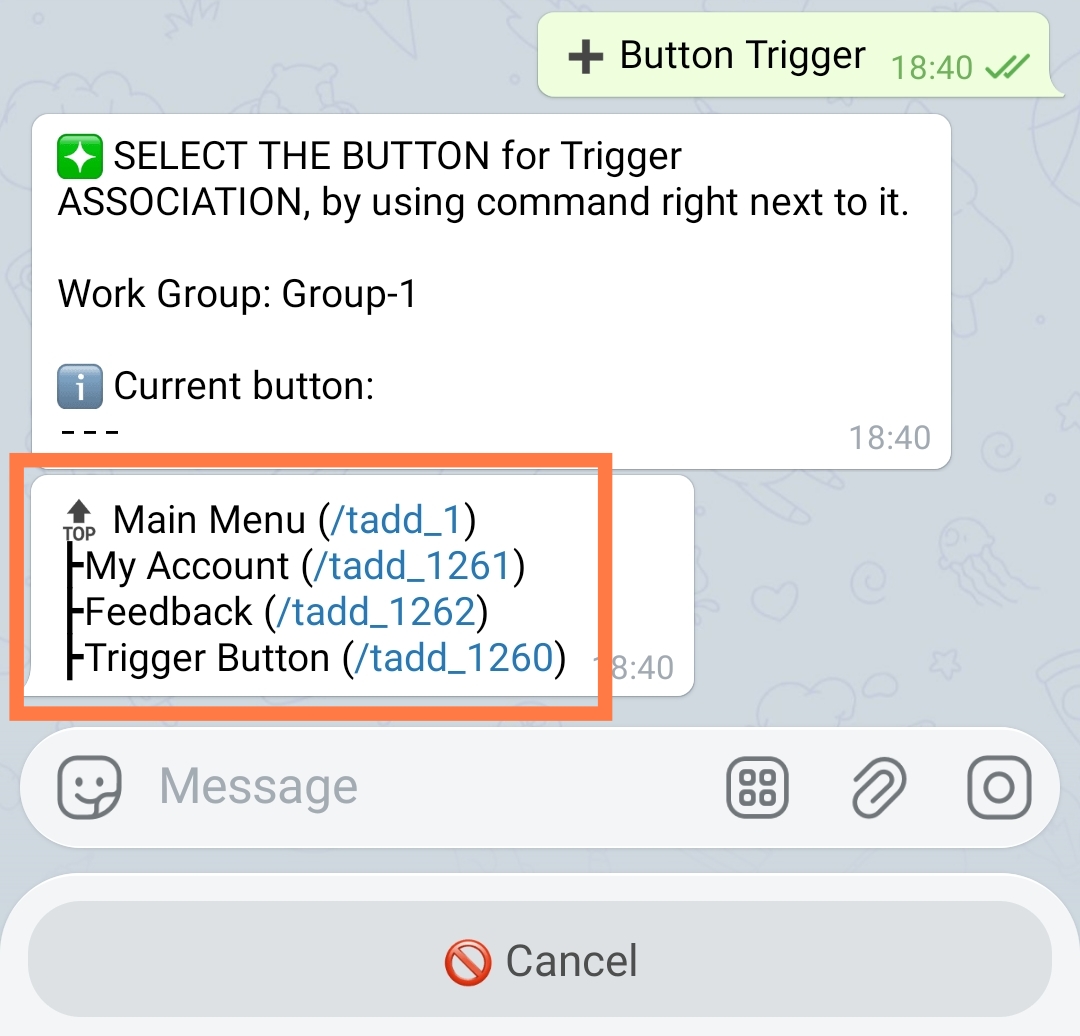
2. Selection of Button
Select the button you want to bind the trigger to, by clicking its command in the menu tree:
3. Trigger name and its Individual settings.
Optionally, you can assign Custom Settings to the Trigger before entering its Name. For a description of each setting, see above in this document or in the editor's informational message.
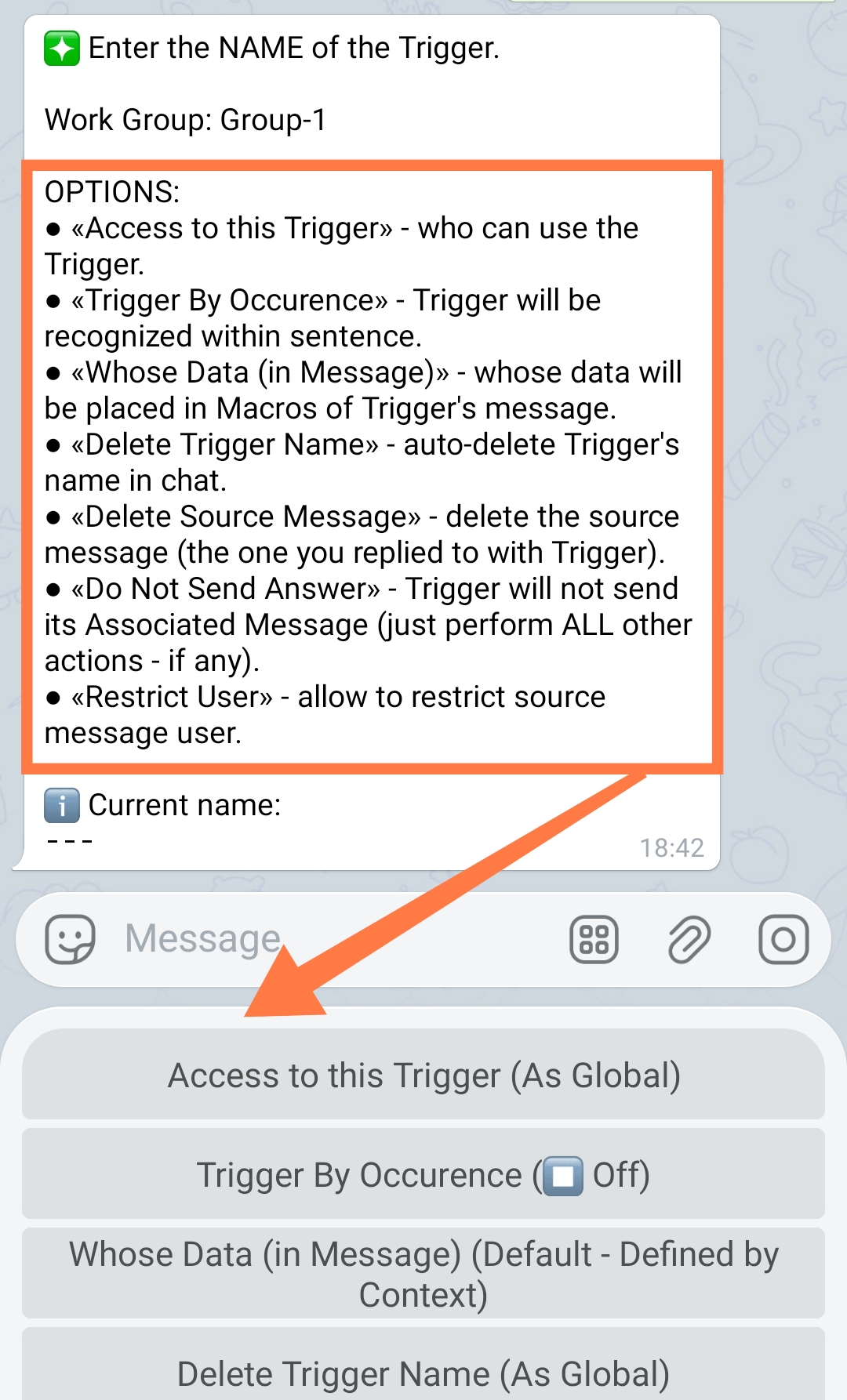
Enter a Trigger Name - when the bot sees a message with this text, it will respond to it with messages from the button:
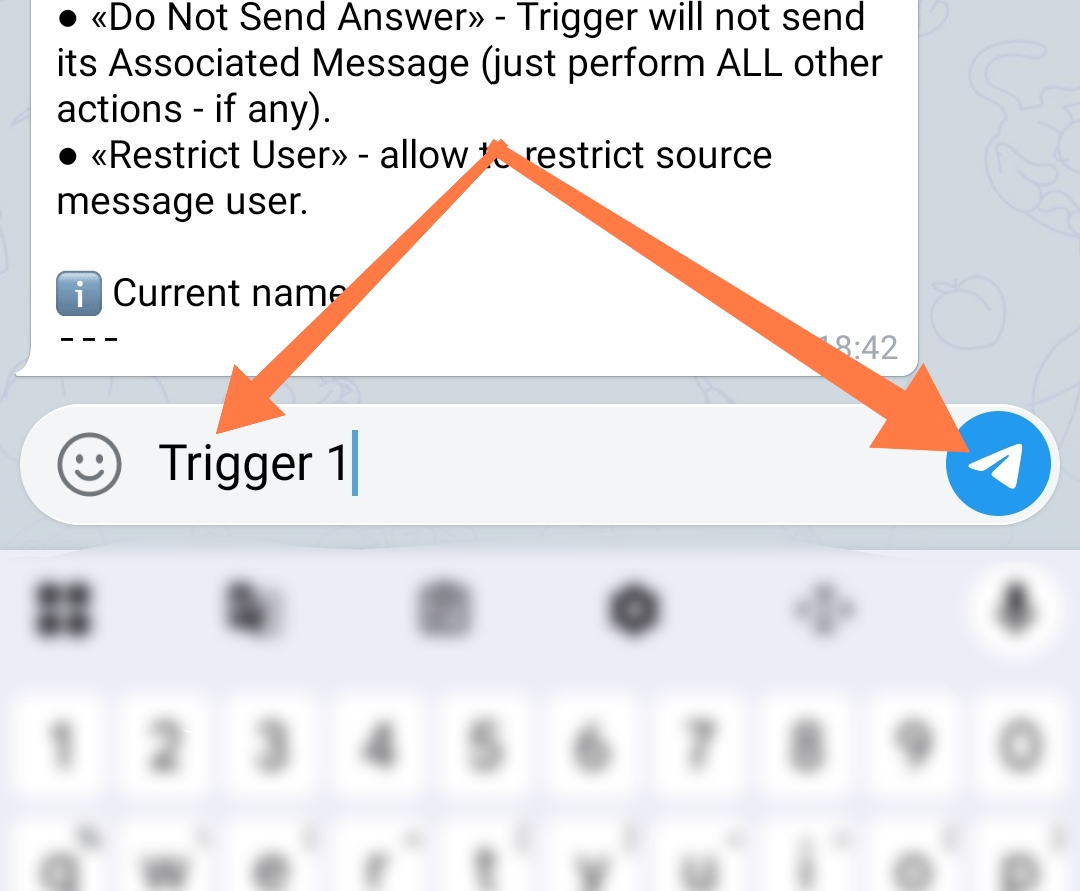
This is all.
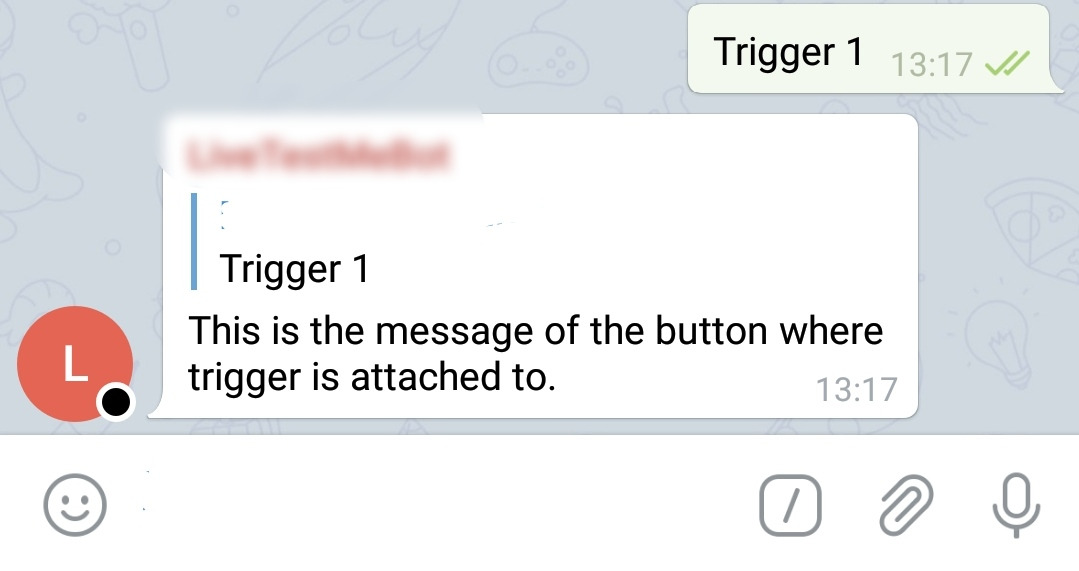
You've now configured a trigger named "Trigger 1", which will send a message(s) to the group from the "Trigger's Button" in your menu. The Trigger data message contains icons of its settings, allowing you to visually understand what the trigger does without opening the editor.
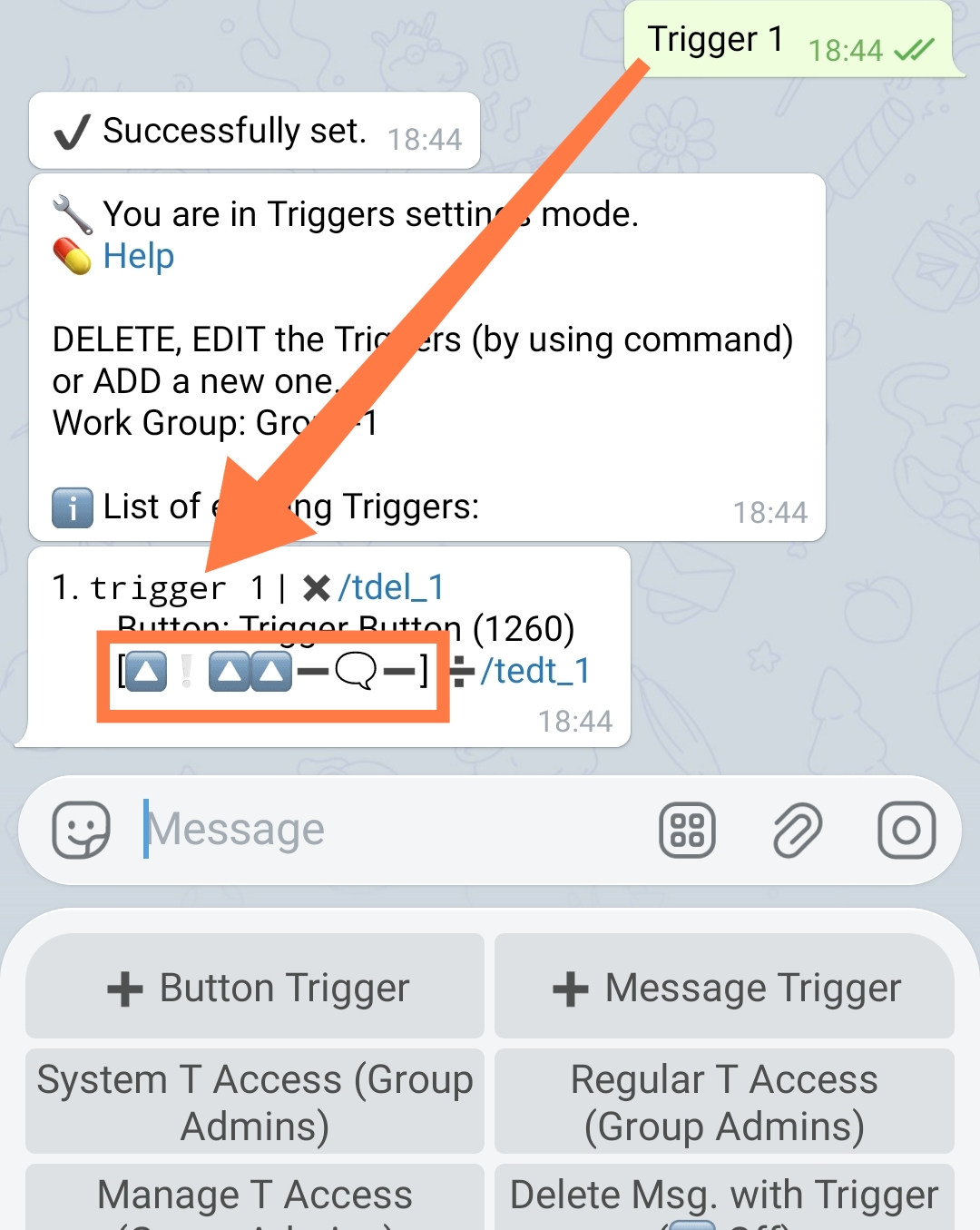
One button can be assigned with multiple triggers.
New «Message Trigger» (from settings)
1. Select «➕ Message Trigger»
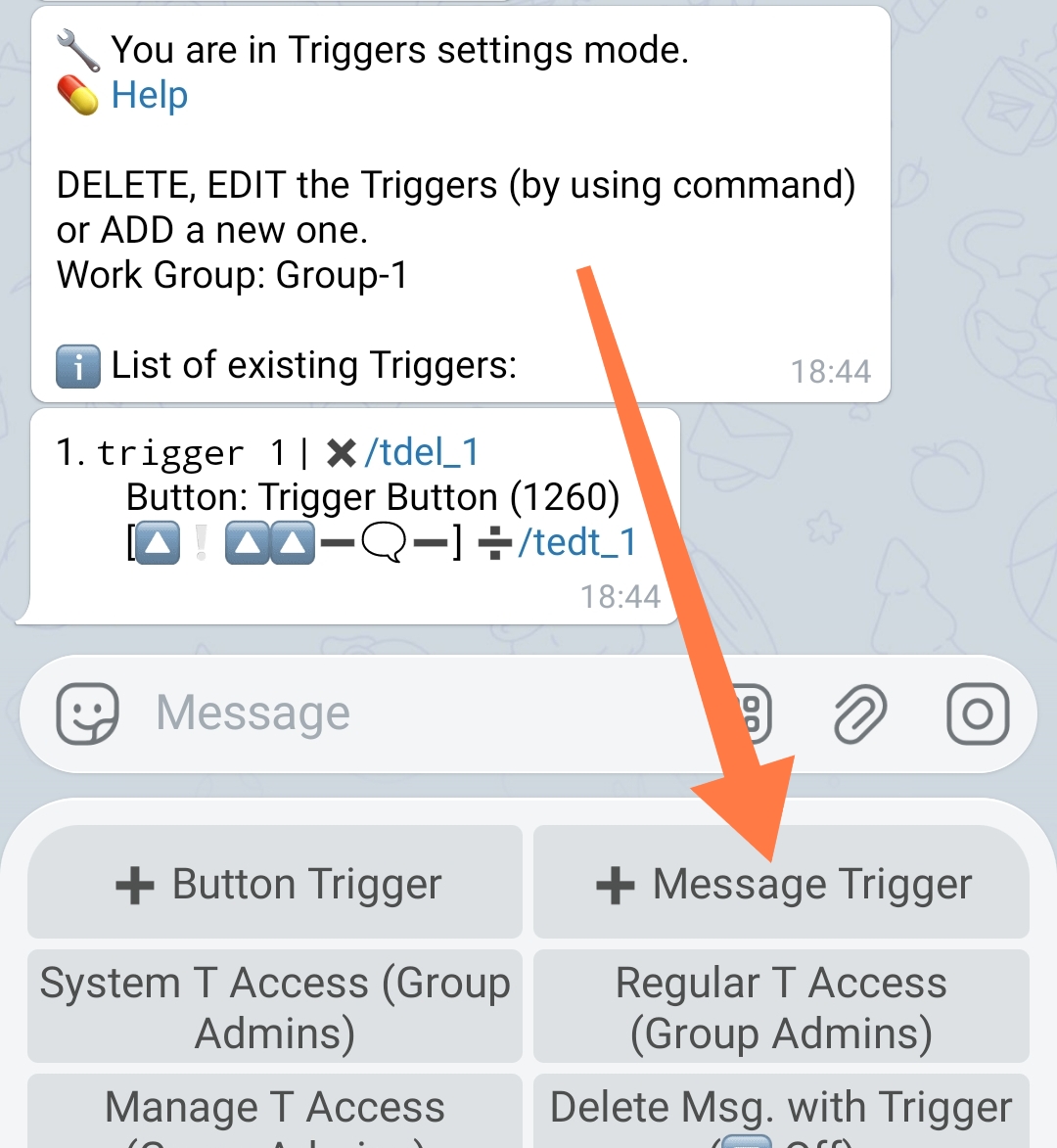
2. Enter or forward a message to the bot.
3. Send the Trigger's Name to the bot.
That's it - the trigger is added!
New «Message Trigger» (from group)
Message Triggers can be added using any message in your group.
It is convenient, if in a GROUP you found some useful answer, yours (or a group member's), and you could use it later to answer a similar question.
In response (reply) to the desired message, send the following command:!tadd trigger_name
Where: trigger_name is the name of the trigger you want to create.
The desired Trigger will be added to the bot and ready to use immediately. The trigger will use the Global Settings and default settings for Triggers.
When triggers in the form of commands (like: /trigger) are used in groups, some Telegram clients, perceiving the Trigger as a Command and passing the Trigger's Name to the bot with addition of the bot's name itself. When creating Triggers in the form of Commands for the use in groups, you do not need to duplicate the trigger with the addition of the name of the bot itself.
The bot's name, which is automatically added when used in a group, will be cut off during processing.
For example Trigger:/trigger@bot_name
will be processed as:/trigger.
❖ How to Edit Triggers
To edit any Trigger from the trigger list, click on the "Edit Trigger Command" in the Trigger settings:
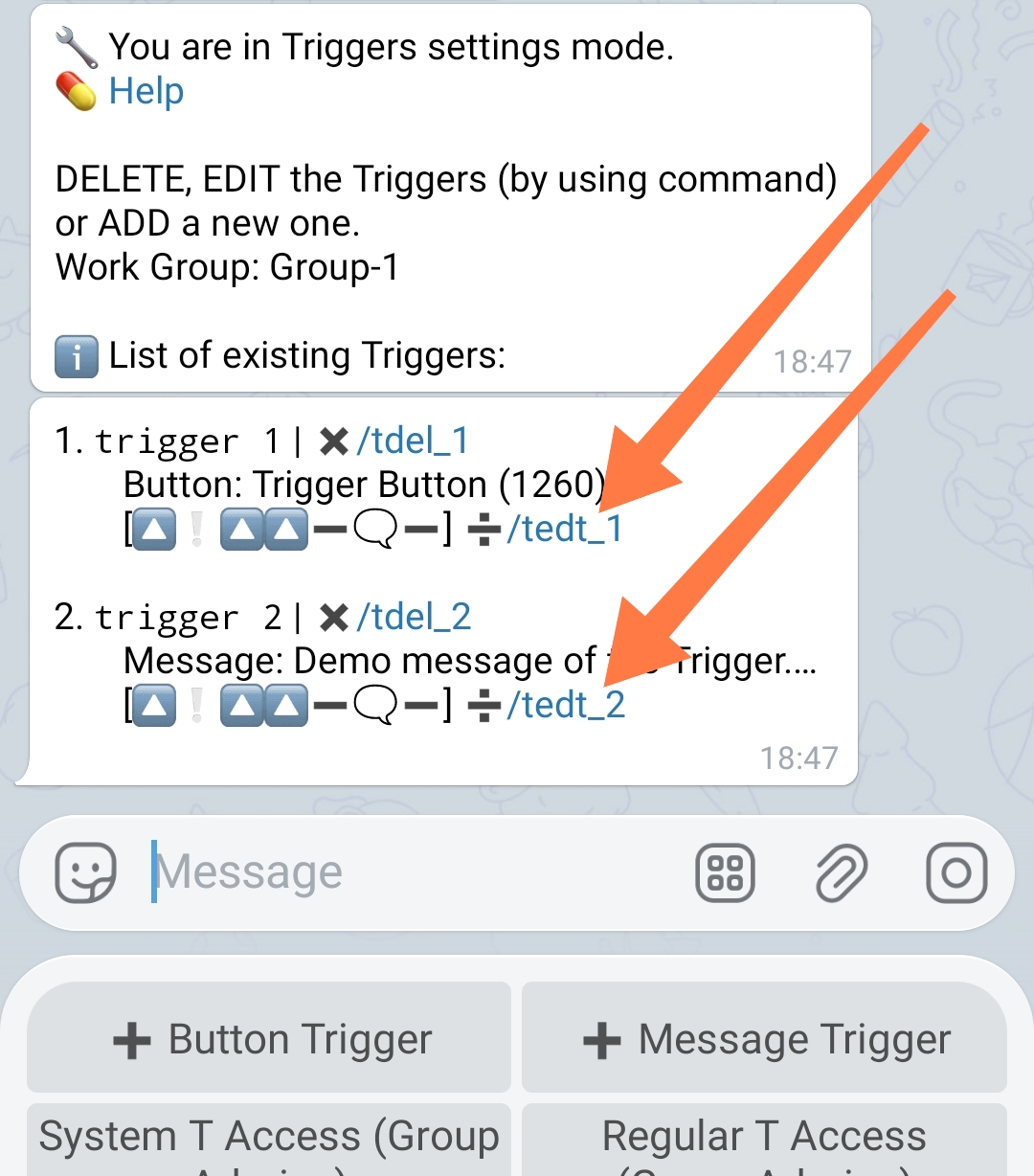
Editing a Trigger is completely identical to adding it (see above).
❖ How to Delete Triggers
Method 1 (in settings)
To delete any type of Trigger from the list of triggers, click the "Delete Trigger Command" in the Trigger settings:
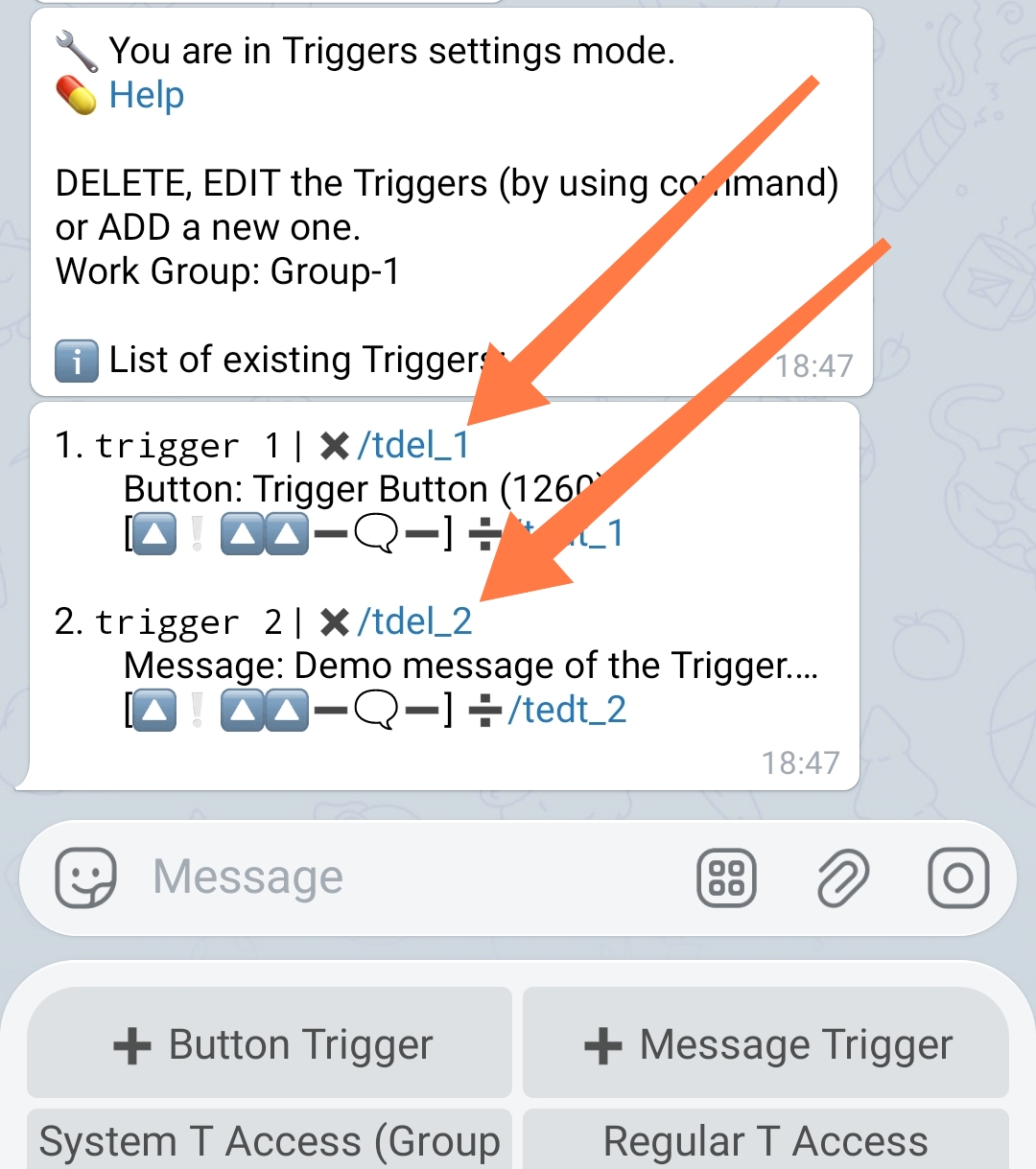
Method 2 (in a group)
Triggers can be deleted directly in the group; you don't need to access the bot itself. Send the following command to the group where the bot is running:
!tdel trigger_name
Where: trigger_name is the name of the Trigger you want to delete.
❖ How to Import Triggers
If you want to use the same Triggers (or some of them) in multiple groups, you can Import Triggers from one group to another.
1. Select a group
Go to Edit Mode of the group where you want to Import Triggers (for this example, we will select group number 2).
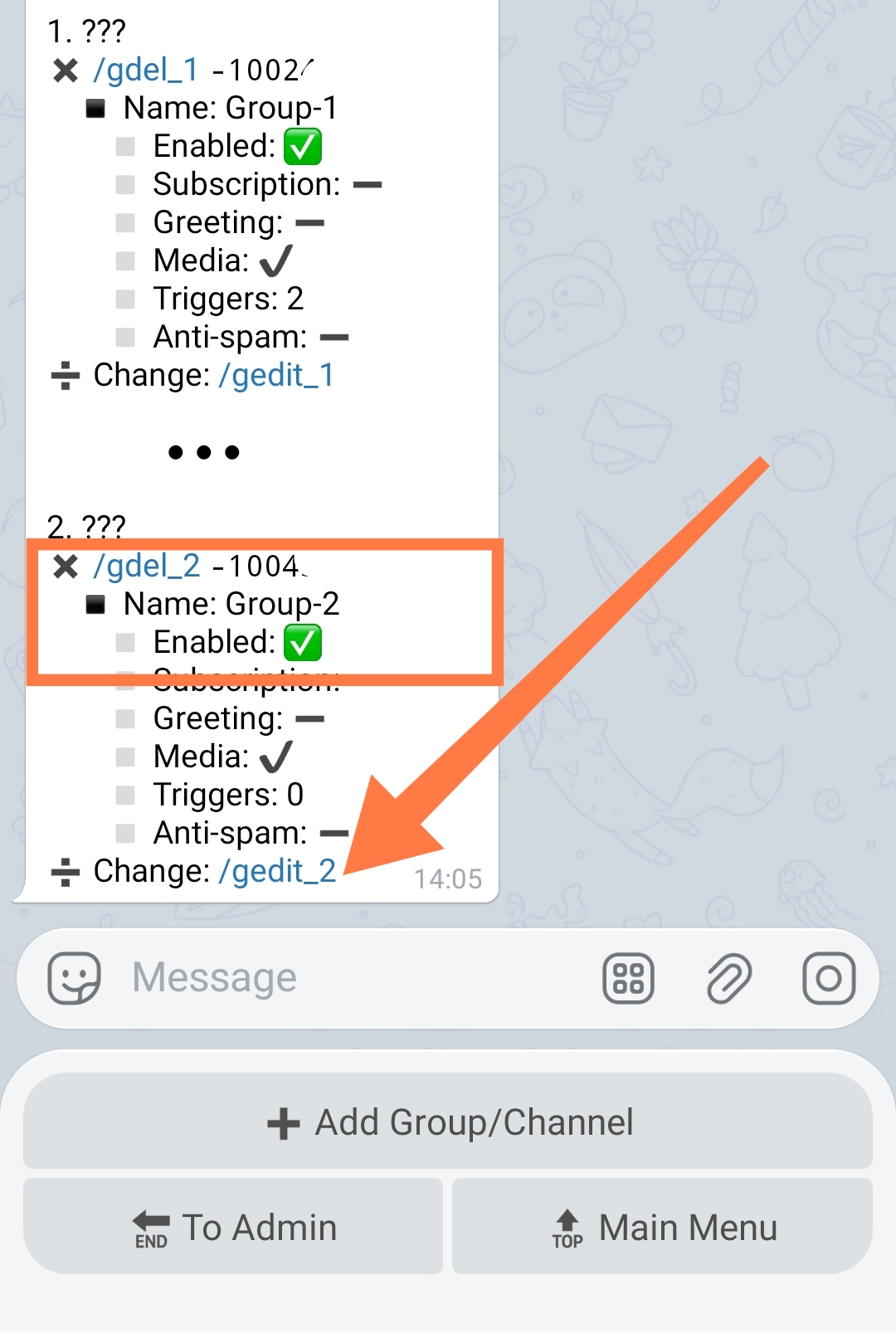
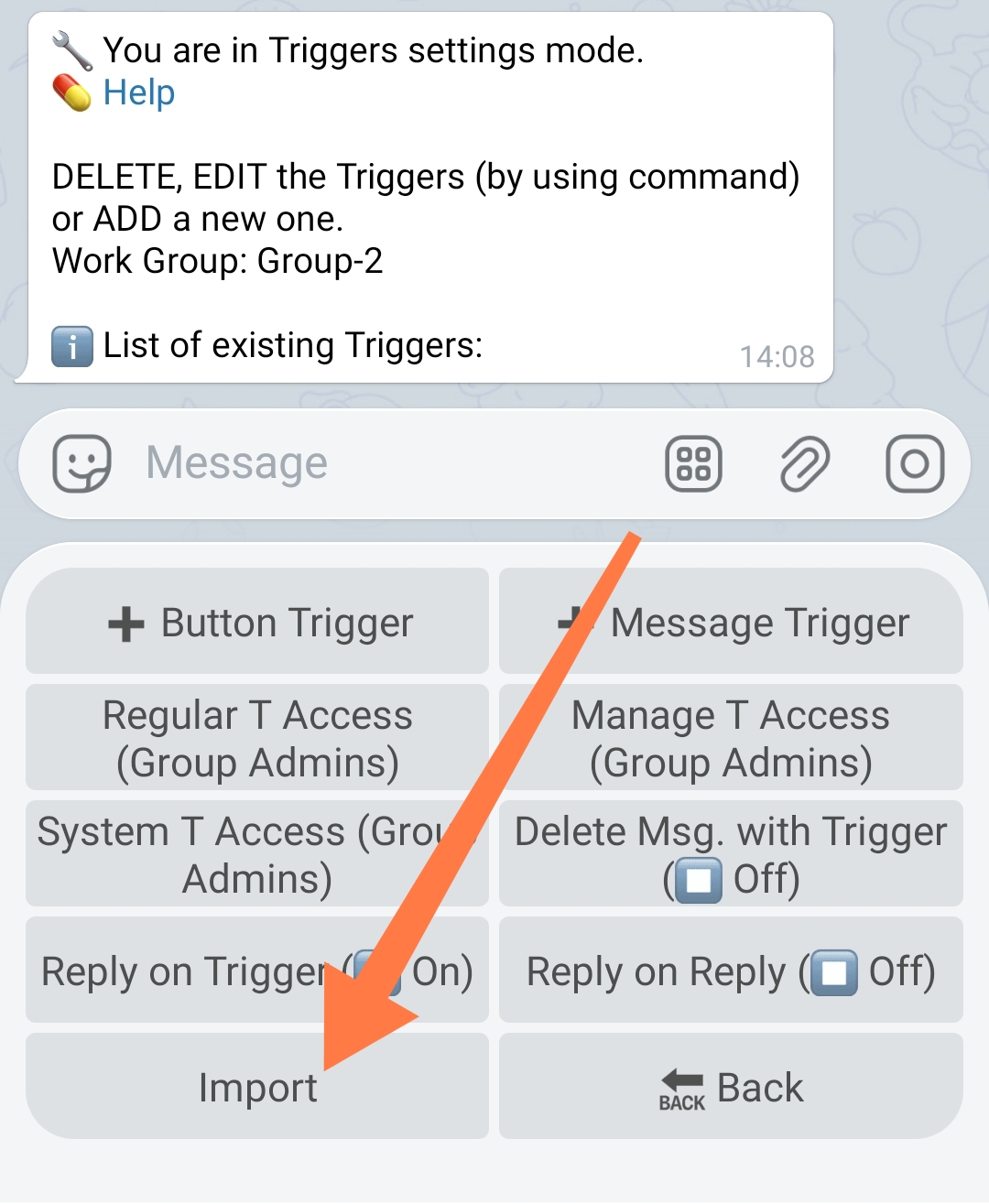
2. Go to «Triggers».
3. Select «Import»
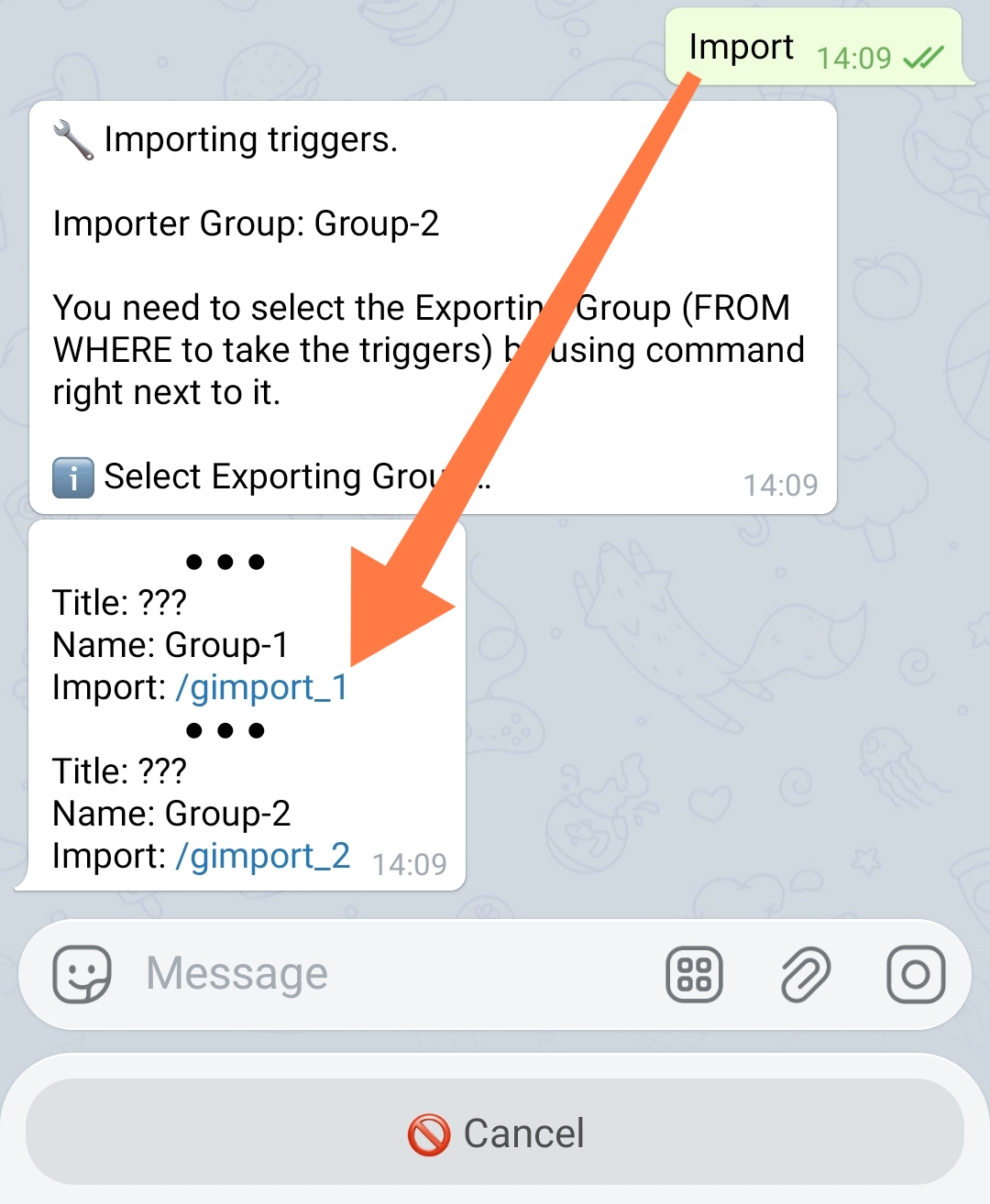
4. Select the source group
Select the source group (Exporter) by clicking on the "Group Selection Command" (for this example we will select group number 1).
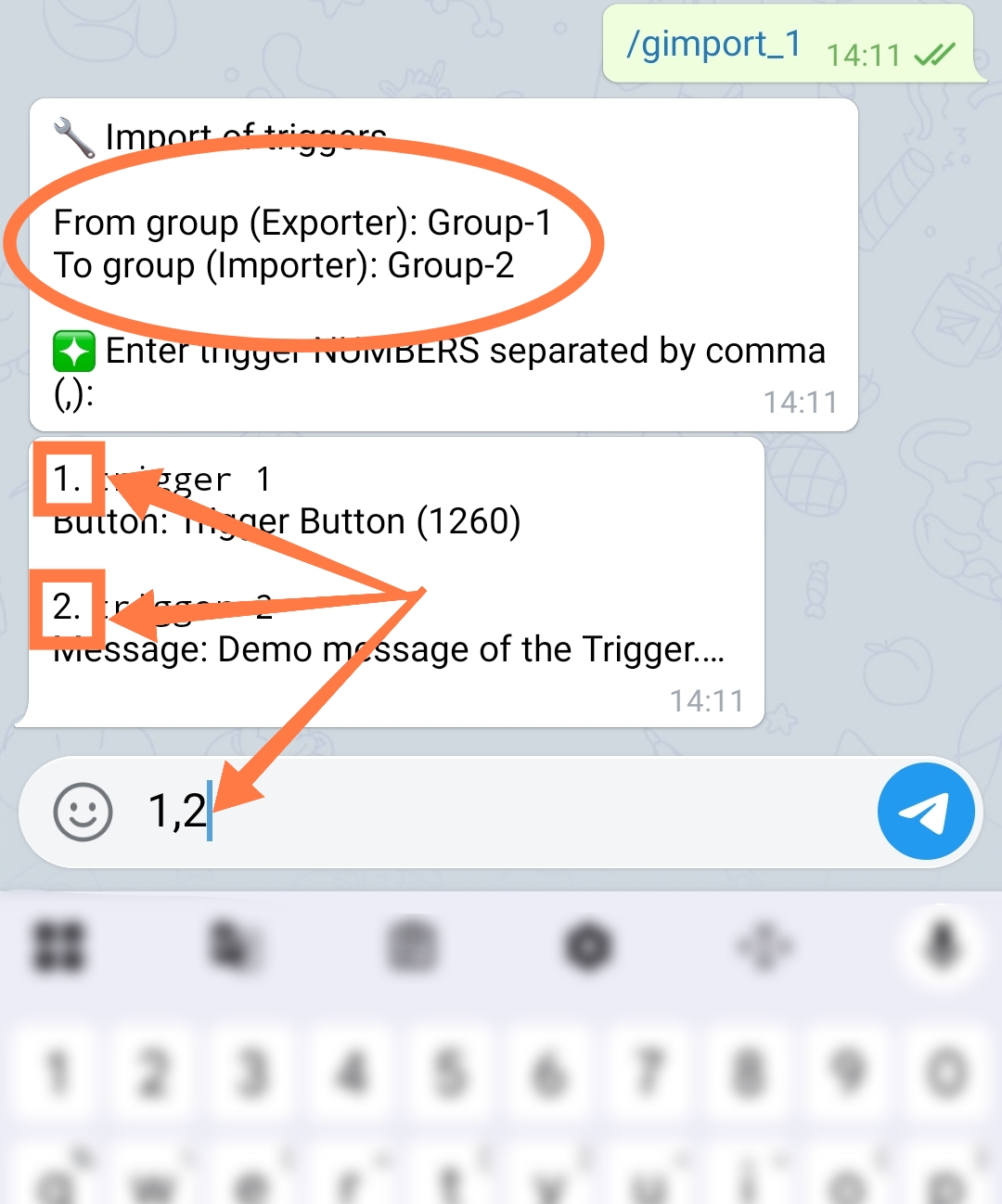
5. Select Triggers to Import
The bot will send a list of available Triggers in a single message. Select the Triggers to Import by entering their numbers, separated by commas:
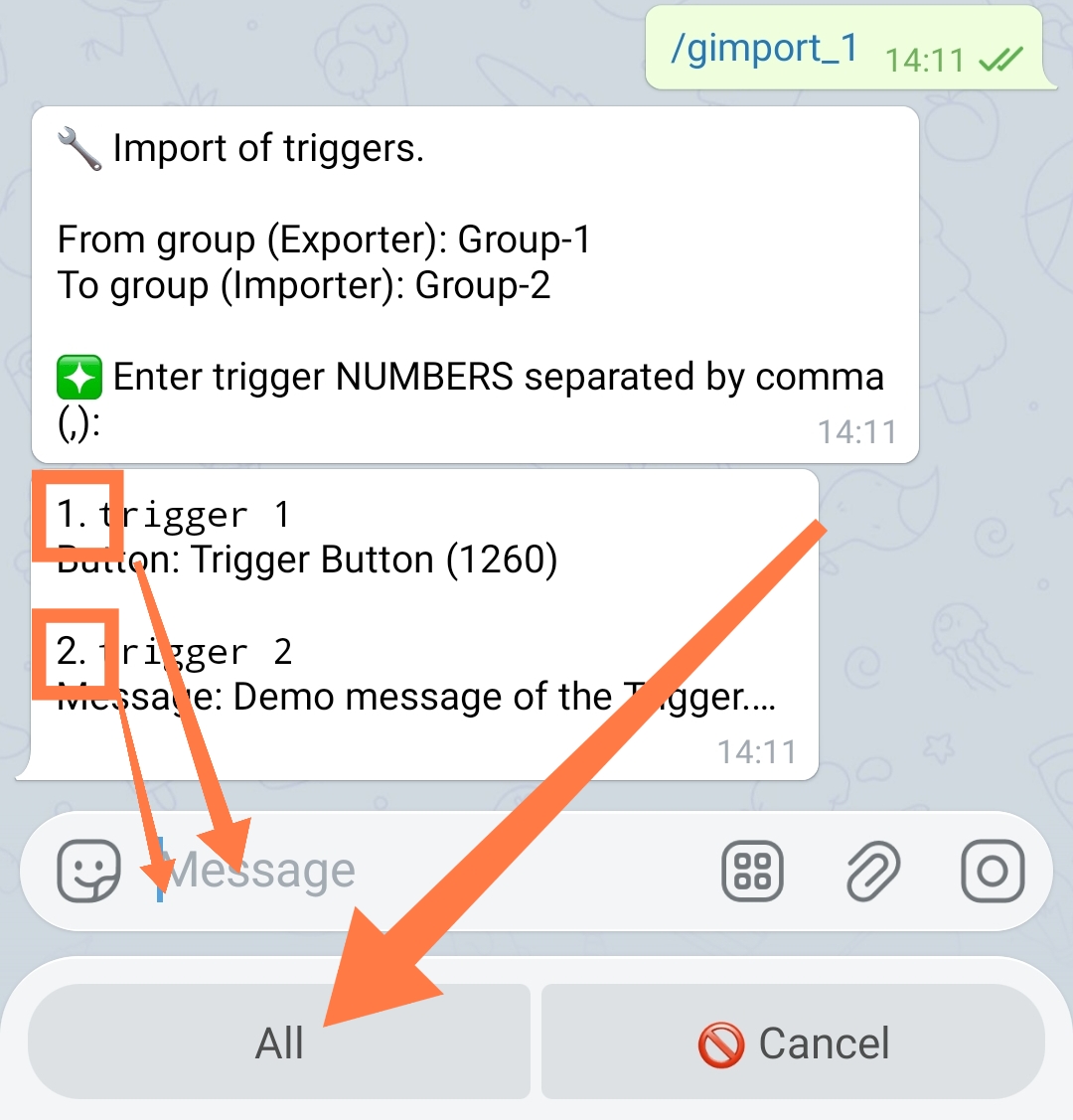
If you want to Import all Triggers, use the «All» button in the lower menu.
Now the same Triggers are configured in the new group.
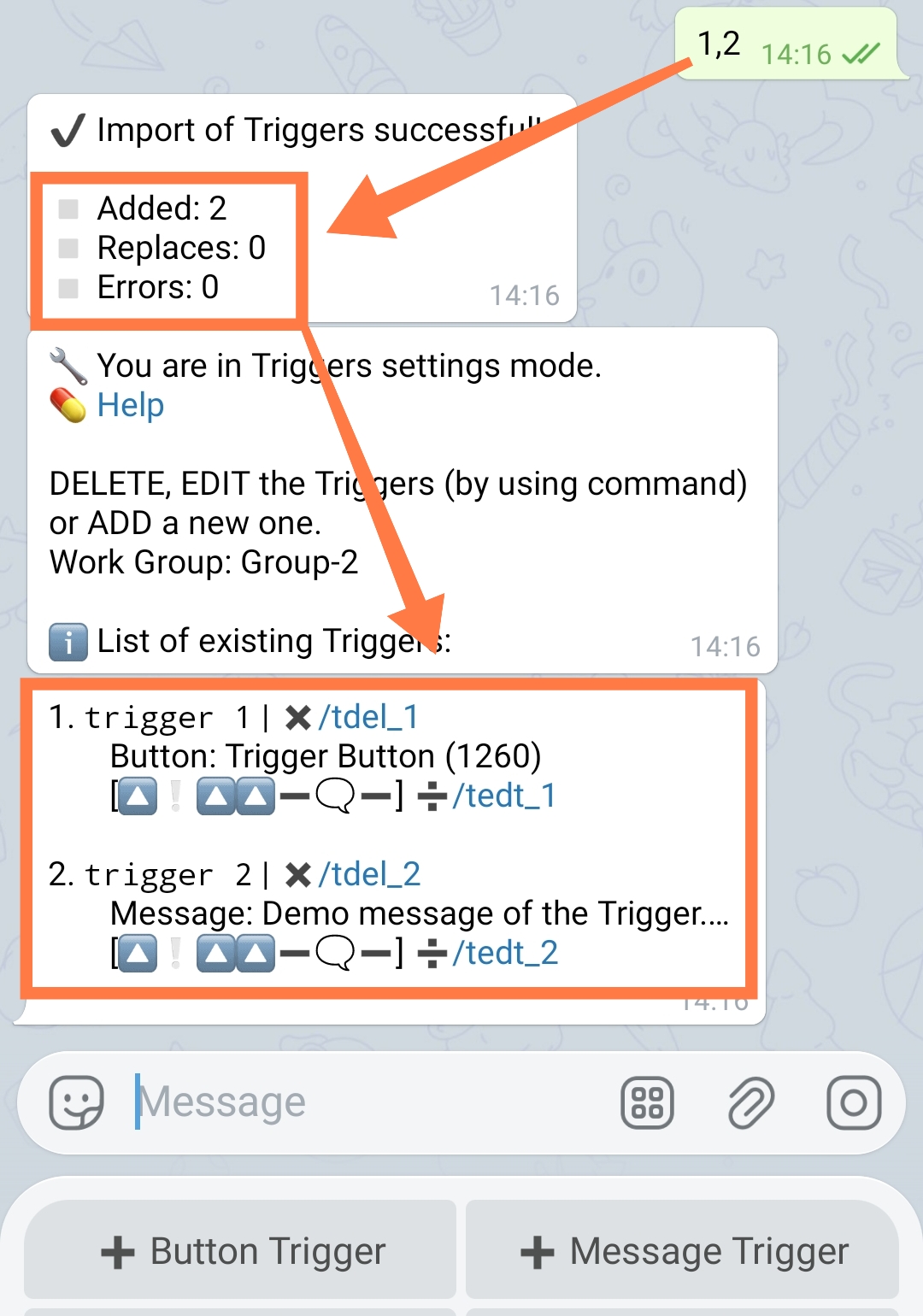
During the Import process, Triggers with unique names will be added. Triggers with matching names will be replaced.
❖ Service Triggers
The system provides special Trigger commands for service needs.
t or T (one letter "t"): will send all available Triggers in the group. The message will be automatically deleted after sending any Trigger from the list.
Other service commands may be added later.
❖ Errors when working with Triggers
Bot does not respond to Triggers in a group
Option 1: The Trigger was sent by the user of the group, and the bot is configured to work only with Admins - see the settings and set the one you need.
Option 2: You have just added an Admin to the group and the bot has not yet updated the lists of Admins - send the !admins command to the chat, in order to force the lists to be updated.
❖ Additional information
How to get more triggers
The number of triggers can be increased.
More Triggers.
To connect, go to your bot:🔐Admin | 🧩Extensions | 📂Channels and Groups
Additional triggers are purchased per bot, permanently, and can be added to any group of this bot.
Once acquired, Additional Triggers will never disappear. If you remove an Additional Trigger from a group or delete the entire group at all, the Additional Triggers are released and can be used again in another group.